

Wholesale Lotus Flowers: How Should B2B Buyers Source Them from China?
سبتمبر 5, 2026
Wholesale lotus flowers can be sourced from China in many forms, including artificial lotus flowers, dried lotus components, decorative lotus arrangements, lotus-themed ornaments, and related gift products. The right sourcing strategy depends on the intended application, material, product size, order volume, customization level, packaging, and target market. For B2B buyers, the main challenge is not simply finding lotus products. It is matching the right supplier with the required quality, design, production volume, and commercial terms.
The lotus has a distinctive position in decorative products and cultural merchandise. The sacred lotus, Nelumbo nucifera, has long-standing cultural significance across Asia. Kew identifies it as an important plant in Hindu and Buddhist traditions, while also documenting its ornamental, food, and material uses.
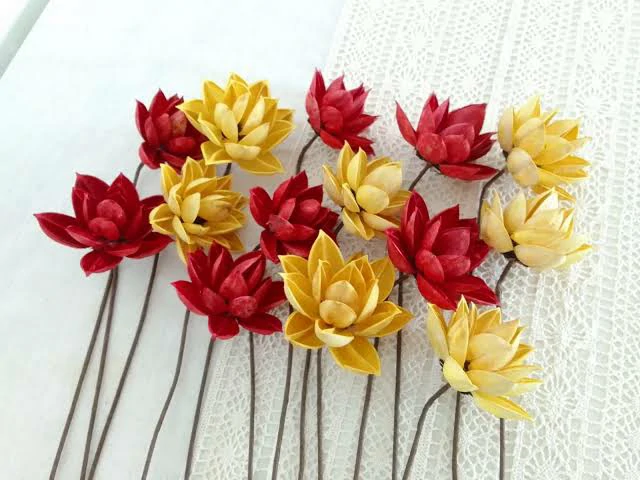
This broad cultural background creates many commercial applications.
A buyer may need artificial lotus flowers for home décor. A hotel may require lotus arrangements for interior decoration. A gift company may source lotus-themed ornaments for a seasonal collection. A religious goods distributor may need specific flower shapes and colors. An event company may require large quantities of artificial lotus flowers for temporary installations.
These projects look similar at first, but their sourcing requirements can be very different.
A retail product may require individual packaging and barcode labels. A hotel project may prioritize size consistency and bulk packing. A gift collection may require custom colors and coordinated accessories.
The following guide explains how B2B buyers can structure wholesale lotus flower sourcing and reduce common procurement problems.
What Types of Wholesale Lotus Flowers Can Buyers Source?
“Lotus flowers” can refer to several product categories.
Before contacting suppliers, buyers should define whether they need natural, dried, preserved, artificial, decorative, or lotus-themed products.
This distinction affects the supplier base, production process, packaging, storage, and transportation requirements.
Artificial Lotus Flowers
Artificial lotus flowers are commonly used for decorative applications.
They can use different materials depending on the required appearance and price structure.
Common materials include:
- Polyester fabric
- Silk-style synthetic fabric
- Plastic
- EVA
- Foam
- Paper
- Mixed materials
Fabric petals can provide a softer appearance.
Plastic structures may provide greater dimensional stability.
Foam can support lightweight decorative designs.
The choice should match the intended environment.
A hotel decoration project may require large flowers that retain their shape during installation. A retail gift product may require smaller flowers with compact packaging.
Dried Lotus Flowers and Seed Heads
Dried lotus components have a different commercial purpose.
Dried seed heads, stems, and related botanical materials can appear in floral arrangements and decorative products. Kew notes that dried lotus seed heads are used in flower arranging.
Natural dried products require different handling from synthetic flowers.
Moisture control becomes important.
Storage conditions can affect appearance and product stability. Packaging must also protect fragile structures during transportation.
Import requirements can vary by destination and product type. Buyers should confirm applicable plant or agricultural regulations before placing an international order.
Lotus-Themed Decorative Products
The sourcing category can extend beyond the flower itself.
Related products may include:
- Lotus candle holders
- Lotus ornaments
- Lotus-shaped trays
- Lotus wall décor
- Lotus lanterns
- Lotus centerpieces
- Lotus-themed gift items
- Artificial lotus leaves
- Decorative pond accessories
- Floral arrangement components
This creates an opportunity to source several related products through one project.
However, each product can require different manufacturing capabilities.
A factory that produces artificial flowers may not manufacture metal lotus ornaments. A decorative ceramics supplier may not produce fabric flowers.
Supplier matching therefore becomes important when building a broader product collection.
How Should Buyers Choose Materials, Colors, and Designs?
Product appearance strongly affects the commercial value of decorative lotus products.
However, appearance should be translated into measurable specifications before production.
A supplier needs more than a general description.
Define the Flower Dimensions
Specify the product size clearly.
Relevant measurements may include:
- Flower diameter
- Petal length
- Petal width
- Flower height
- Stem length
- Leaf diameter
- Base dimensions
- Finished product weight
For example, “large pink lotus flower” is not enough for production.
A better specification could define a flower diameter, petal structure, stem length, material, color reference, and packaging format.
This gives multiple suppliers the same basis for quotation.
Color Matching
Lotus flowers can be produced in many colors.
Common options include white, pink, red, purple, yellow, and mixed shades.
However, color names can create inconsistent results between suppliers.
For repeat production, buyers should provide a physical sample, color reference, or agreed digital standard.
The factory should also clarify whether color changes require a new material order or production setup.
This matters when a product collection includes several color variations.
Petal Construction
Petal construction affects appearance and production cost.
A flower with fewer large petals requires a different production method from a flower with many small petals.
The attachment method also matters.
Petals may use stitching, adhesive, molding, heat forming, wire support, or other methods depending on material.
Buyers should inspect the petal attachment points during sampling.
Loose petals can create quality problems during transportation.
Stem and Leaf Design
The flower should not be evaluated separately from its supporting components.
Artificial lotus products may include stems, leaves, bases, wires, or decorative supports.
The stem diameter affects stability.
The leaf size affects the overall arrangement.
The connection between flower and stem can affect durability.
A complete sample review should therefore examine the entire product rather than only the flower head.
What Should B2B Buyers Check Before Ordering Wholesale Lotus Flowers?
A sourcing project should begin with a clear technical and commercial specification.
This prevents suppliers from quoting different versions of the same product.
It also makes price comparison more meaningful.
Product Specification
The RFQ should define:
- Product type
- Material
- Dimensions
- Color
- Construction
- Weight
- Accessories
- التغليف
- Quantity
- Customization
- Target delivery date
For natural or dried products, add relevant information about moisture, treatment, packaging, and storage.
For artificial products, define material and surface requirements.
The more specific the product, the more important a technical reference becomes.
MOQ
MOQ can vary significantly between factories.
Standard products may have lower MOQs because the supplier already purchases the required materials.
Custom products can require higher quantities.
A new mold, custom color, special fabric, or custom packaging may require a minimum production volume.
Buyers should ask for MOQ based on the actual specification.
Do not assume the supplier’s standard MOQ applies to customized products.
Sampling
Samples should come before mass production.
A sample allows the buyer to confirm:
- Shape
- Dimensions
- Color
- Material
- Petal construction
- Stem structure
- Accessories
- التغليف
- Overall appearance
For custom designs, several sample rounds may be necessary.
The approved sample should then become a production reference.
This process is particularly important when the product will be reordered.
Customization
Lotus products can support several levels of customization.
The simplest option may involve selecting an existing product and changing the color.
A more advanced project may require a new flower shape.
Other options include custom packaging, branded labels, special arrangements, custom bases, and coordinated product sets.
Each additional customization requirement can affect tooling, MOQ, lead time, and unit cost.
Buyers should therefore separate standard products from genuinely custom products during the RFQ stage.
How Does Packaging Affect Lotus Flower Sourcing?
Packaging deserves more attention than many buyers initially expect.
Artificial flowers can be lightweight but bulky.
Dried lotus components can be fragile.
Large decorative flowers may become deformed if cartons compress them during transportation.
Packaging therefore affects both product quality and freight cost.
Individual Retail Packaging
Retail products may require:
- Individual polybags
- Printed boxes
- Hang tags
- Product cards
- Barcodes
- Instruction cards
- Branded inserts
The packaging specification should be confirmed before the supplier calculates the final unit price.
Otherwise, a quotation may exclude important packaging components.
Bulk Packaging
Hotels, event companies, wholesalers, and decoration suppliers may prefer bulk packaging.
This can reduce packaging cost and simplify handling.
However, bulk packing requires careful internal protection.
Flowers should not become compressed or tangled.
The carton size should also match the product geometry.
A larger carton does not automatically provide better protection.
It can increase freight volume without improving product safety.
Carton Efficiency
Transportation cost often depends on volume rather than product weight.
This is particularly relevant for artificial flowers.
A lightweight flower can occupy significant carton space.
Buyers should therefore review:
- Units per carton
- Carton dimensions
- Gross weight
- Net weight
- Carton configuration
- Container loading estimate
Packaging optimization can sometimes reduce total landed cost without changing the product itself.
How Can Buyers Control Quality for Wholesale Lotus Flowers?
Quality control should focus on the characteristics that affect the buyer’s application.
Not every project requires the same inspection standard.
A retail brand may focus on appearance and packaging.
An event supplier may focus on quantity, size consistency, and transportation durability.
A large decorative project may prioritize uniform color and dimensional consistency.
Pre-Production Control
Before bulk production begins, confirm the approved sample.
The supplier should also receive the final specification.
This document should identify the material, dimensions, colors, packaging, and customization requirements.
Any changes should receive approval before production continues.
During-Production Inspection
Early production inspection can identify problems before the entire order is completed.
Inspectors can compare finished units with the approved sample.
They can check flower dimensions, color, petal attachment, stems, leaves, and packaging.
This approach gives the factory time to correct production problems.
It also reduces the risk of discovering a large batch problem at the end of production.
Final Inspection
Final inspection should verify both quality and quantity.
A typical inspection can cover:
- Product appearance
- Dimensions
- Color
- Material
- Assembly
- Accessories
- التغليف
- Carton markings
- Quantity
The inspection method should reflect the product risk and order value.
For structured quality systems, ISO 9001 provides a framework for organizations to establish and continually improve quality management processes.
ISO 9001 does not define a specific quality level for lotus products. It provides a broader management framework for controlling processes and meeting customer requirements.
What Are the Main Cost Factors for Wholesale Lotus Flowers?
The lowest factory unit price does not always produce the lowest sourcing cost.
B2B buyers should evaluate the full cost structure.
Material Cost
Material selection can create significant price differences.
A simple fabric flower may have a different cost structure from a molded plastic flower.
Natural dried materials also have different procurement and handling requirements.
The buyer should compare suppliers using the same material specification.
Otherwise, the cheapest quotation may simply use a different material.
Labor and Assembly
Lotus flowers with multiple petals require assembly.
The number of petals, attachment method, and product structure affect labor requirements.
A simple flower can have a relatively short assembly process.
A detailed decorative arrangement may require several production steps.
This makes direct price comparison difficult unless the product structure remains identical.
Tooling
Custom shapes may require molds, dies, cutting tools, or other production fixtures.
Tooling charges should be separated from unit pricing.
Ask whether the tooling cost applies once or repeatedly.
For long-term programs, clarify how the tooling will be stored and used for future orders.
How Can a Sourcing Agent China Support Lotus Flower Procurement?
Sourcing from China requires more than finding a product photo and requesting a quotation.
The supplier must be able to reproduce the required product at the target quantity and quality.
أ وكيل توريد محترف can support supplier identification, quotation comparison, sample coordination, factory communication, production follow-up, inspection, and shipping preparation.
The role becomes particularly useful when the buyer needs several related products.
Supplier Matching
Different lotus products require different manufacturing capabilities.
For example, an artificial fabric flower supplier may not produce ceramic lotus ornaments.
A paper decoration factory may not have the equipment needed for molded plastic products.
A supplier should therefore be selected according to the product’s manufacturing process.
ومن بين العوامل المهمة ما يلي:
- Product specialization
- Material capability
- Production capacity
- MOQ
- Customization
- Sample capability
- مراقبة الجودة
- القدرة على التعبئة والتغليف
- الخبرة في مجال التصدير
The objective is to find a supplier that fits the project.
Multiple Supplier Comparison
A sourcing project can involve several potential factories.
Each supplier should quote the same specification.
This creates a meaningful comparison.
For example, the sourcing team can compare:
| Supplier | Material | MOQ | سعر الوحدة | Sample Lead Time | Bulk Lead Time |
|---|---|---|---|---|---|
| Supplier A | Specified | Confirm | Quote | Confirm | Confirm |
| Supplier B | Specified | Confirm | Quote | Confirm | Confirm |
| Supplier C | Specified | Confirm | Quote | Confirm | Confirm |
The comparison should also include packaging and tooling.
A supplier with a higher unit price may provide better packaging or include additional services.
The final decision should consider the complete quotation.
Sample Coordination
Sampling becomes especially important when buyers work from product photos.
A photograph cannot communicate every production detail.
It may not show material thickness, petal attachment, product weight, or packaging strength.
The sample converts a visual reference into a physical production standard.
The buyer can then approve or revise the product before mass production.
How Should Sourcing Agents Manage Custom Lotus Products?
Custom products require a more structured process than standard products.
The buyer needs to define what can change and what must remain fixed.
Custom Design
A custom lotus flower may involve:
- New petal shape
- Different flower diameter
- Custom color
- Modified stem
- Custom leaf
- New base
- Logo application
- التغليف حسب الطلب
Each change can affect production.
The supplier should evaluate the design before confirming the final quotation.
Custom Packaging
Packaging can also become part of the product development process.
A branded box may require artwork approval, printing, cutting, folding, and assembly.
Packaging samples should be reviewed separately when necessary.
This prevents a product from being approved while the packaging remains unresolved.
Production Documentation
For recurring orders, a documented specification can improve consistency.
The record should include the approved sample and key measurements.
It can also include material requirements, color references, packaging details, and inspection points.
This creates a common reference for future orders.
A quality management framework can support this process by controlling documented information and production activities. ISO identifies documented information, operation, performance evaluation, and improvement as parts of its quality management framework.
What Related Products Can Be Sourced With Lotus Flowers?
A lotus-themed collection can include more than individual flowers.
B2B buyers may combine several product types into one sourcing program.
This can help create coordinated collections for retail, hospitality, events, gifts, and seasonal decoration.
Decorative Accessories
Potential related products include:
- Artificial lotus leaves
- Lotus-shaped candle holders
- Decorative bowls
- Floral arrangement bases
- Lotus lanterns
- Table centerpieces
- Wall decorations
- Hanging ornaments
The advantage of combining products is not simply convenience.
It can also create a consistent design language across a collection.
However, buyers should avoid forcing all products through one factory when the factory lacks the required manufacturing capability.
Gift and Seasonal Products
Lotus imagery can work across different gift categories.
A supplier may combine lotus elements with packaging, ornaments, candles, home décor, or other accessories.
The target market should guide the design.
Cultural meaning also deserves attention.
Kew documents the lotus’s significance in Hinduism and Buddhism and identifies India and Vietnam as countries where the lotus serves as a national flower.
A product intended for a culturally specific market should therefore use appropriate colors, symbols, and presentation.
What Should B2B Buyers Ask Wholesale Lotus Flower Suppliers?
A structured supplier questionnaire can reduce misunderstandings.
Product Questions
Ask:
- What material does the product use?
- What are the exact dimensions?
- What is the finished product weight?
- Can the color be customized?
- Can the flower shape be modified?
- What accessories are included?
Production Questions
Ask:
- What is the standard MOQ?
- What is the MOQ for custom products?
- Is tooling required?
- What is the sample lead time?
- What is the bulk production lead time?
- What production capacity is available?
Packaging Questions
Ask:
- Is individual packaging included?
- What packaging materials are used?
- How many units fit in one carton?
- What are the carton dimensions?
- What is the gross weight per carton?
Quality Questions
Ask:
- How does the factory control product consistency?
- How are materials checked?
- How are finished products inspected?
- Can the supplier provide inspection records?
- Can the supplier reproduce the approved sample for repeat orders?
These questions create a better basis for supplier comparison.
FAQ About Wholesale Lotus Flowers
What are wholesale lotus flowers used for?
Wholesale lotus flowers can serve home décor, hotels, events, retail products, floral arrangements, cultural merchandise, gifts, and seasonal decoration. The required product type depends on the application.
Can I source artificial lotus flowers from China?
Yes. China has manufacturers and suppliers covering artificial flowers, decorative products, gift items, and related components. Supplier selection should match the required material, quantity, customization, and quality requirements.
What materials are used for artificial lotus flowers?
Common materials include polyester fabric, plastic, EVA, foam, paper, and mixed materials. The appropriate material depends on the required appearance, structure, durability, and cost.
Can lotus flowers be customized?
Yes. Customization can include size, color, petal structure, stems, leaves, bases, packaging, and branding. More extensive customization may require tooling and higher MOQ.
What is the MOQ for wholesale lotus flowers?
There is no universal MOQ. Standard products may have lower MOQs than custom products. Material, tooling, packaging, and production requirements can all affect the minimum quantity.
Should I order samples before placing a bulk order?
Yes. Samples allow buyers to check dimensions, materials, color, construction, appearance, and packaging. For custom products, sample approval should occur before mass production.
How should artificial lotus flowers be packaged?
Packaging depends on product size, fragility, and sales channel. Retail products may use individual packaging. Bulk orders may use protective carton packing with internal separation.
Are dried lotus flowers different from artificial lotus flowers?
Yes. Dried lotus products are natural botanical materials and require different storage, handling, and import considerations. Artificial flowers use manufactured materials and generally follow a different supply chain.
Can I source related lotus products from the same supplier?
Sometimes. A factory may offer several related products within the same manufacturing category. However, different materials and processes may require different suppliers.
How do I compare lotus flower suppliers?
Compare the same product specification across suppliers. Review material, dimensions, MOQ, unit price, tooling, packaging, sample quality, lead time, production capacity, and inspection arrangements.
Why use sourcing agents for lotus flower procurement?
A sourcing partner can help identify suitable suppliers, compare quotations, coordinate samples, communicate specifications, follow production, and arrange quality inspections. This can be useful for buyers without an established supplier network in China.
Final Considerations for Wholesale Lotus Flower Sourcing
Wholesale lotus flower sourcing requires more than selecting an attractive product from a supplier catalog.
The first step is to define the product category.
Natural dried flowers, artificial flowers, decorative arrangements, and lotus-themed accessories have different sourcing requirements.
The second step is to define the specification.
Material, dimensions, color, structure, packaging, and quantity should be clear before supplier comparison.
The third step is to evaluate the factory.
Product specialization, production capability, MOQ, customization, quality control, and lead time all affect the suitability of a supplier.
The fourth step is to validate the product through samples.
A physical sample gives the buyer a reliable reference for bulk production.
The fifth step is to calculate total landed cost.
Product price, tooling, packaging, inspection, freight, and other sourcing expenses should form part of the commercial evaluation.
For long-term programs, buyers should also maintain a consistent product specification and approved sample.
This makes repeat orders easier to control.
A well-managed sourcing process can also support broader product development. Instead of purchasing one lotus product, buyers can develop a coordinated collection across flowers, decorative accessories, gifts, and packaging.
MarsGift is a China sourcing company supporting international buyers with supplier identification, product sourcing, customization, sampling, quality control, production follow-up, and shipment coordination. The company works with businesses sourcing gifts, decorative products, accessories, and customized merchandise from Chinese suppliers. Its sourcing process focuses on matching product requirements with suitable factories and managing the commercial and production details needed for international orders.
المراجع
- Royal Botanic Gardens, Kew, “Sacred Lotus, Nelumbo nucifera”
Kew Science: Sacred Lotus - Royal Botanic Gardens, Kew, “Nelumbo nucifera Gaertn. | Plants of the World Online”
Kew Plants of the World Online - International Organization for Standardization, “ISO 9001 Quality Management Systems”
ISO 9001 - International Organization for Standardization, “ISO 9000 Family: Quality Management”
ISO 9000 Family